
The subject of AI is at the forefront of young writers’ futures. Such an important subject must, therefore, touch each young writer in some way and affect their writing and publishing process. As a young writer myself, I would like to drive home a simple but possible danger of AI’s encroachment.
Scientists have demonstrated that letting AI handle the heavy work of thinking and even writing is dangerous for our brain’s logical capacity. For example, a July 2026 article titled “How AI Is Reshaping Human Skills and Thinking” quotes Professor Mutlu Cukurova as saying, “At the moment, most interactions between people and generative AI are transactional. You ask a question; you get an answer; you move on. Unfortunately, these types of interactions are more likely to lead to cognitive atrophy than cognitive development.”
We stand to lose more than we gain, literally, when we don’t do the work ourselves.
Of course, doing the work ourselves takes time and, above all, failure. Perhaps we are uncomfortable with failure and are therefore more than glad to hand off the job to an AI bot. But hard work at something implies that you are not perfect at some point in the process, hence the need for self-application. But if our doing involves so much loss, why should we cling to it?
The key to understanding why we should embrace process is that rejecting the concept of process is rejecting what life is. And really, when we do something ourselves and suffer losses at our own hands, we net-gain from that failure—perseverance, wisdom, patience, experience, efficiency. Conversely, when we surrender process to AI, we lose without a chance to regain, having been robbed of ourselves.
In this article, I will examine a few processes for inspiration and idea-generation that I find helpful for writing and critical thinking, and that I think we should not surrender to AI.
Listing
Most of us have experienced a lack of inspiration at some point. Just like you, I have often Googled ideas for writing. Of course, Google answers are now AI-driven, providing a long list of perfectly summarized, optimized answers at the top of the screen.
Are these helpful? They can be.
But if the AI engine is synthesizing this information from the web at large, what’s to stop you from following your own rabbit trails in search of ideas? I have often arrived at my best ideas by not following the suggestions, instead combing disparate information to reach my own conclusions
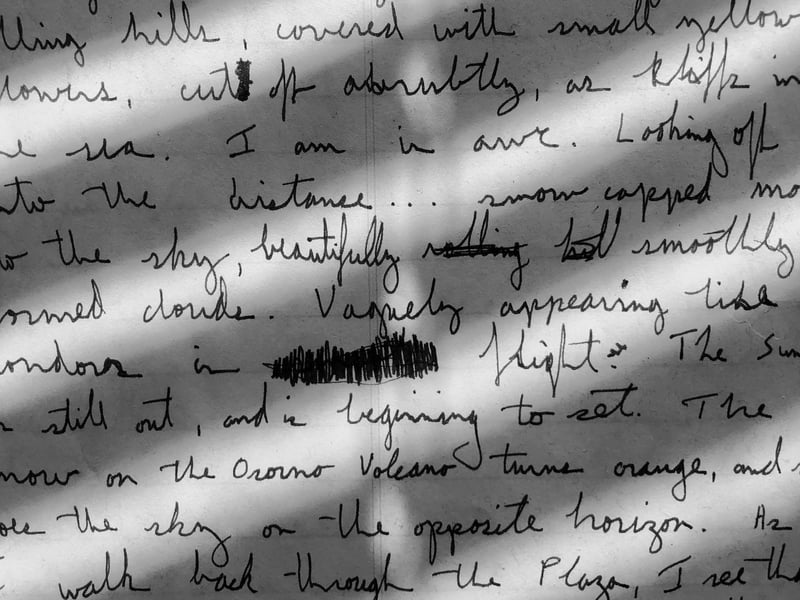
Failing at first to find a good idea does not mean you should automatically quit and give the process up to AI. Grab a lined sheet of paper (this is my favorite method) and a pen, and write “Topics” at the top. Then, start listing ideas—ones that you may have already written before, ones that you may have read recently, ones that you may have had on your mind for a while.
Write silly ideas that make you giggle, write embarrassing ones that make you roll your eyes, write boring ones just for the sake of writing them down. You may take three lines or three pages to get to an idea. I rely on this method when I have absolutely no idea what to write. And generally, I have an idea I am not just interested in but excited about by the end of the hour.
Here are several ways to make your listing more creative through annotation:
- Draw arrows in the page margins
- Create boxes around important notes
- Star or number the ideas in the order you like them
- Engage with the material to keep the process fresh, drawing connections, noting questions, or otherwise making your list more dynamic
Of course, the point is that each rejected idea is a little failure that forces you to take up your pen and try again. Besides forcing your brain to exercise, you have to think about how you would write about the topics that you are listing, so that when you arrive at the one you like, you already have a rough draft sketched in your brain.
Brainstorming
An alternative to listing ideas on a physical page is brainstorming. I used to turn my nose up at this one because I thought that I could just sit down and type away without preliminary work. While I still do that from time to time, I have found brainstorming to be worth the effort. Essentially, it allows you to jumpstart your drafts.
I like to open a blank document in Word and label it “Brainstorm” at the top. Then, I label one section of the document “Title Ideas” and number title ideas underneath it. (These tend to get increasingly unhinged, or vice versa.) Again, following through with the process will benefit you more than plugging an idea into ChatGPT and asking for a title, because a self-made title can drive the entire idea. Never underestimate a title and try not to surrender its hard-won creation.
After the titles section, I label a second section “Brainstorm for First Lines/Paragraphs.” This section is my favorite because it is so effective. The hardest part of a draft is probably the beginning. Just getting started is either daunting or boring. But the brainstorm removes that impediment by giving you free space to experiment without making you feel as if you are wasting time on an opening.
Number each of your ideas in this section, too. Feel free to highlight ones that you think make a better ending or to cut and paste paragraphs into each other. This practice saves a massive amount of time when it comes to drafting, because you can copy and paste into your first draft document and already be well into your work.
Again, trying and failing at an opening is beneficial if you stick with the process; it inspires you to write the rest of the piece after you have put in the hard work at the front end.
Outlining
After brainstorming, when I have a pretty good idea of what I want to write about, I open another document labeled “TENTATIVE Outline” to remind myself that what I write here is subject to change. I then plan out my introduction, conclusion, and each body paragraph, all labeled as such. Don’t treat this part as a formal outline for school. Instead, be very informal with its structure, using phrases, sentences, questions, quotes, even lines that you want to include later.
The outline is itself a representation of failure because it is not a perfect, untouchable product. Admittedly, you can achieve an outline from AI and tweak it. But you have not put in the hard work of thinking out a piece’s structure, its individual parts. Reserve all creative rights where you can.
AI is often excused in the writing world as a prompt-generator and a creative companion. Perhaps so. But even if you are not using it to write entire stories, I still think inspiration is a hard-won part of the writing process that should require thought and intentionality just as much as the rest of it. Even using AI for picture ideas robs potential artists around you (or in you) of the opportunity to exercise their artistic skills.
Either way, AI robs us of a key component of creativity—failure. And we need to fail in order to learn.
About the author
Alaina Suttles is a senior at Pensacola Christian College where she is studying for a bachelor's degree in professional writing. When she was still in high school, Alaina discovered Write the World and fell in love with its welcoming community. She won runner-up for a Write the World fantasy competition and later won first place for her college's creative fiction competition. As a young writer, Alaina was grateful to discover Write the World's community of fellow writers, where she could share her work and experience constructive and kind criticism that helped her grow her writing skills. Now, as a summer intern, she hopes to build that same confidence in other young writers and to encourage them to put their talents to the best use.


