
"I owe everything I have now to the bravery of my younger self."
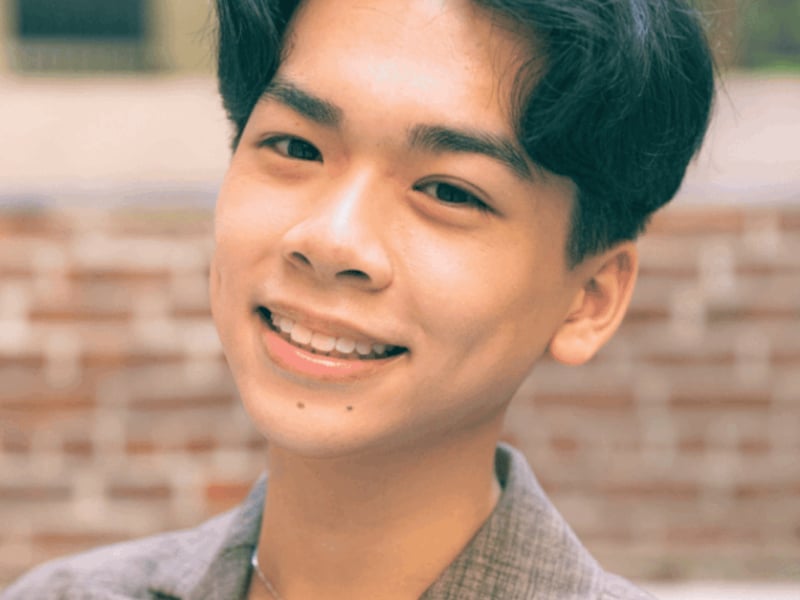
This April, our Poetry & Spoken Word Competition will be guest-judged by the marvelous 王潇 / Evan Wang, author of Slow Burn (Northwestern University Press, 2026), winner of the Drinking Gourd Chapbook Poetry Prize, and the 9th National Youth Poet Laureate of the United States. A teen writer himself, Evan is currently a first-year student at Harvard University whose writing journey began as a local leader in King of Prussia, Pennsylvania. Read on to learn more about his impressive story and expert advice on the art of poetry.
1. You’re the 9th National Youth Poet Laureate of the United States. That's a huge accomplishment! Can you chart your path for our young writers who might hold a similar dream? Where did your interest in poetry originate, and how did you gain recognition as a young poet?
I never imagined holding a national position, or could have anticipated how much space poetry would occupy in my life. In the beginning, writing was a mode through which I attempted to understand my tumultuous teenage years. It began so simple: love poems, poems about family, mental health poems. Slowly, I found my hunger for more poetry insatiable. I took on larger projects, longer poems that captured more depth. Along the way, recognition came in well-timed moments. There was never a single moment that established my presence as a young poet, rather, it was the culmination of years that brought me into the spotlight. I organized with community organizations, submitted poetry to countless literary magazines and journals, and competed in dozens of competitions. I owe everything I have now to the bravery of my younger self.
2. You’re also the first male and Chinese individual to hold that title. In what ways does that distinction affect your experience as a National Youth Poet Laureate (if it does!)?
This is a great question! The distinction does not directly affect my experience so much as it frames my mindset when approaching my work and identity throughout the term. Because this is a public-facing position, my presence in every space carries the weight of representation. With every performance and published piece, I prove that the vulnerability and intimacy of poetry extends to all genders. With every interview and profile, I carry my culture and my people into the public eye. If anything, these distinctions empower my work with purpose and allow me to closely interact with communities who may have previously felt “othered” by poetry.
3. Can you tell us a bit about your writing process? For example, if you’re writing a poem, what does the evolution of the piece look like over time? Do you have a writing and editing process that you adhere to?
My process varies with every poem, but I like to begin with a collection of thoughts. Over the span of weeks, I note down phrases or images in the world that have a poetic spark. There are a select few that continue to return to me, and those form the foundations of a poem. From there, I begin to build. A good poem is not easily predicted by the first line, so I try not to dream of endings. The making of the poem might take a week, but the revision may take months. I put distance between me and the piece for a few days, then look back at it with fresh eyes. In this way, I become my own editor. This is the ideal process, but there are moments when I feel especially troubled and the poem comes out in a torrent. In these cases, revision is key, but the process is much quicker.
4. Many of your poems are written in English, but contain Mandarin words. We have many multilingual poets on Write the World. What is your process for blending two languages into the same poem?
This aspect of my poetry is at once selfish and selfless. For one, I want to reconnect with my heritage through poetry. Chinese poetry has an incredible history, and expanding its contemporary scene is a goal of mine. On the other hand, I think about Chinese immigrants and their children who feel distanced from either English or Mandarin. By writing bilingual poems, I try to close those gaps. I offer them a morsel of familiar land. It is also a beautiful way to magnify the nuances in language. There are certain expressions and messages in Mandarin that English cannot capture. However, I am cautious about using Mandarin in my poems too. It has to be justified. I ask myself these questions: Why is this phrase in Mandarin? Is it something I want to hide from English-speakers? Does this phrase relate to my culture? Is the poem about culture?
5. Your book, Slow Burn, tackles the suppression of the self within cultural, societal, and political systems. Why, in your opinion, is it so vital for young people to speak out and have their voices heard? And how can poetry—written or spoken—be an effective vehicle for that work?
Not only are young people the rising caretakers of the world, we currently carry the most ambitious, affected, and outspoken voices. The passion associated with the youth can enact widespread change, shift our culture of thinking, and redefine the status quo. However, the old guard often restricts our access to those important platforms. As such, poetry and the arts are the most accessible forms of democracy for the youth. It has given me power. It can give everyone else power. In Slow Burn, I try to exemplify that every personal feeling is a celebration of agency and individual power, and thus is revolutionary.
6. What are you looking for in a winning entry? Any tips for our young writers, especially those new to poetry and spoken word?
I am looking for honesty. So often are writers too afraid of speaking their truth—what really haunts, worries, or activates them. I am not looking for a journal entry, but refined radical clarity. Do so by reflecting on standout experiences, memories, and images, and ask yourself why focus on those specific moments? What does my obsession about that scene say about me? Question yourself, question if the form fits what the poem is saying, question if the poem actually begins halfway through the poem. Be detailed. Do not be afraid of speaking the thing out loud.