
I started writing when I was six years old in Miami. My world: swimming with medusas, tropical hurricanes, and red flamboyán trees tall enough to tickle the brazen sun. When I was eight, we moved to New York City, where, in a brick-and-stone desert, nature was hard to come by. Yet its forces–the river, the rain, the seasons–were still ever-present. When I was thirteen, my mom made a radical decision to reverse-migrate us to Havana, Cuba, which only made me want to write more; this time, about the hot hickory sand land of our island. In the summers, we visited my dad, living in a remote town in New Hampshire, which existed among bears; citrus; resinous forests; mountains on the horizon; and vast, cool lakes.
Inevitably, my environment became essential in the stories I told. As I moved through city and country throughout my childhood, writing about the relationship between people and nature not only defined my literary voice, but showed me who I really was. Yet literature has long explored humanity's symbiosis with the wilderness. Let’s take a closer look at three examples from literature.
Kobayashi Issa and Haiku
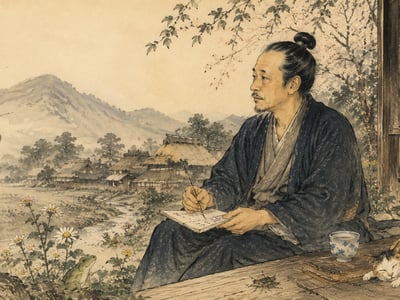
Haiku (or hokku) is a Japanese verse form traditionally divided into 17 mora (a Japanese unit of syllable weight) and arranged in a single vertical line as an opener to a renga sequence.
Crucially, haiku capture ordinary instances of the natural world from the eyes of a human observer, for which an intense emotional response, insight, or realization is evoked. Each one of these micro-poems must contain a kigo, a traditional seasonal word that is closely linked to the Japanese culture’s sensitivity to temporal changes and the sentiments they induce.
Let’s look at Kobayashi Issa (1763-1828) from the mountainous Shinano province. Issa was a masterful haiku craftsman delighted by children, creatures, and the Buddhist view of nature, whose work could just as easily inspire a hearty cackle as break a heart one hundred times over. Over in Shinano, peregrine falcons flew about, wild wisteria hung from trees, villages were landlocked by the towering Japanese Alps, and the 228-mile Chikuma River sustained wet-rice farming.
For the first few years of his life, Shinano was Issa’s home: Born in the village of Kashiwabara where his father was a farmer of buckwheat and rice, Issa’s mother died when he was only a toddler and his father remarried to his abusive stepmother. Issa left to the densely-populated, busy Edo (present-day Tokyo) where he enrolled in the school of haiku and eventually married Kiku. Their first two babies died within a month after birth; then, their third baby, Sato, died from smallpox after only one year. In 1808, Issa wrote:
露の世は露の世ながらさりながら
tsuyu no yo wa tsuyu no yo nagara sari nagara
This world of dew is a world of dew, and yet, and yet…
The famous haiku encloses a devastating juxtaposition between nature and humanity. In his poetic diary Oraga haru, Issa’s own words shed light on the meaning of this poem:
“In the end, on the 21st day of Sixth Month, together with the morning-glory blossoms, she withered. Her mother clinging to the corpse, burst into tears. At this moment, although I tried to resign myself to the fact that water, once it flows past, doesn’t come by a second time, or blossoms, once fallen, never return to the trees.… I couldn’t break the chain of love.”
Essentially, Issa is observing the basic Zen Buddhist teaching of impermanence: A world of dew is a world of dew. Everything changes; reality is fragile, and in that lies the world's beauty.
And yet, and yet…When faced with the death of your little girl, how can one accept the laws of reality? Issa, a lifelong follower of Buddhism, challenges the ancient philosophy by underlining the emotional refusal to passively nod along to grief. Although humans are subject to nature’s impermanence, we are stubborn to let go of love in silence.
Toni Morrison’s Rememory
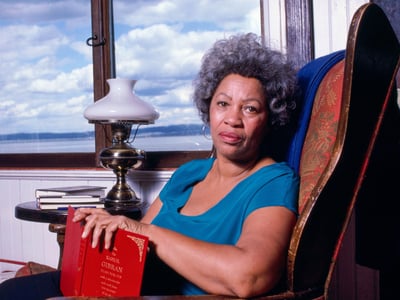
Few authors can write about the relationship between people and nature like the late great Toni Morrison. Known for her raw, incisive, and magical stories of African American reality and her inimitable sensory lyricism, the natural world held a vital place in her work.
What were the environments that followed Morrison throughout her life? She was born and raised in Lorain, an industrial port city on Lake Erie, in the midst of The Great Migration in which Black Americans left the rural South to the Midwest. Lorain was connected to neighboring town Elyria through the Black River, where factory pollution harmed its dark waters. She later lived between a converted boathouse that overlooks the Hudson in Rockland County; Princeton, New Jersey; and various New York City boroughs as she worked as an editor and professor. Throughout her life, these places informed and inspired much of her work: Beloved, Sula, and The Bluest Eye took place in Ohio, while Jazz is set in Harlem, New York City.
In 1987, Toni Morrison published a book centered on the trauma of slavery on the human soul that would lead her to win the 1993 Nobel Prize in Literature: Beloved. The renowned novel follows a former slave and mother, Sethe, who is haunted by the ghost of her baby and the imprisoning memories of her past. In Chapter 3 of the book, Morrison writes about rememory:
Rememory is the idea that our forgotten memories, particularly those that are most powerfully traumatic, exist in physical space. As these entities of the past live beyond the mind, they are grounded by the landscapes and wild objects where their events once took place. In turn, the environment serves as a holder of the past and enables collective remembering from generation to generation.
The Marvelous Real in Alejo Carpentier
Alejo Carpentier was debatably born in Lausanne, Switzerland, or Havana, Cuba. The exact location is unknown because, while he claimed he was born on Maloja Street in Havana, this was likely a comment made to evade deportation.
Regardless of his place of birth, Carpentier was Cuban in everything that mattered. Throughout his life, he lived between dense, cobblestone European cities and the magnetic, tropical Latin America, including Cuba, Haiti, and Venezuela. His time in Caracas during the 1940s led him to the Orinoco river and jungle, which inspired his 1953 Marvelous Real masterpiece, The Lost Steps, about a jaded composer who travels to the depths of the Amazonian rainforest in search of history’s most primitive instruments. As he traverses deeper into the land, civilization grows further, and the wilderness overtakes the world. In the book, he writes:
“A day will come when men will discover an alphabet in the eyes of chalcedonies, in the markings of the moth, and will learn in astonishment that every spotted snail has always been a poem.”
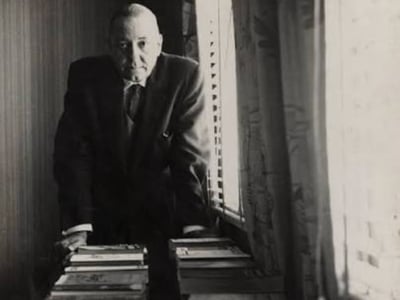
It is one of his most famous quotes which meditates on an idea that societal humans often overlook: the wilderness is an inherent artistic masterpiece that is not meant to be conquered by people in which its meaning comes from our observation.
At the end of the book, the protagonist decides to move permanently to the Orinoco to be with the woman he loves, but first makes a trip back to New York City to divorce his wife and retrieve some materials for his musical composition. Yet upon his return to the Orinoco, the nameless narrator cannot find his way back and must endure the harsh lesson that he was only ever a visitor to the primordial world, and that his modern self will forever prevent him from fully and truly joining the wilderness.
Writing about the relationship between people and nature can take on many different forms, but there is one thing each of these writers from mountainous Japan, the Midwestern United States, and Cuba did do: They draw from their own experiences in the natural worlds that enveloped their childhoods and lives. Then, they greeted the question head-on: How does human nature interact with and reveal the Earth’s wilderness?
Once you heed that advice, you’ll be prepared to enter our Environmental Writing Competition, open through November 23rd, 2026.
About the Author
Tula Jiménez Singer is the Marketing and Administrative Coordinator at Write the World. She graduated from Northeastern University with a Bachelor of Science in Linguistics in 2025, where she focused on Cuban Spanish discourse and dialectology. Before Write the World, she worked in editorial content and journalism at various organizations, including The Boston Globe and The Climate Justice and Sustainability Hub. She also served as President of Artistry Magazine, a university publication exploring global arts and culture. She lives and breathes for writing: since she joined Write the World as a young writer in 2019 while living in Havana, Cuba, she continues to write stories about the Marvelous Real, Cubanism, human culture, and identity.


