

A film or TV show is not something created by one artist—it's a team effort. Actors, directors, producers, and crew members rely on a script to understand timing, tone, mood, and setting. As the architect of that script, you’re responsible for arranging all of these important elements in a way that’s readable and easily transferable. That’s why correct formatting is such an important part of screenwriting.
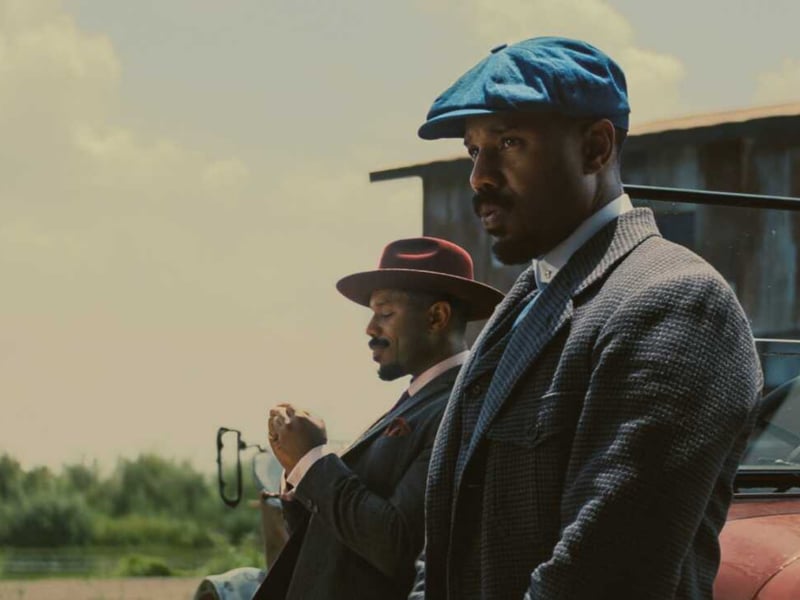
In this guide, we will walk through the different parts of a screenplay. We’ll do so with the help of examples pulled from Sinners, the 2025 film written and directed by Ryan Coogler, which was nominated for an Oscar for Best Original Screenplay (and currently holds the record for most Oscar nominations ever!). If you’re still getting familiar with the many terms and abbreviations used in screenwriting, check out our comprehensive list here.
Part 1: Scene Heading (Slugline)
The scene heading, or slugline, is written in ALL CAPS and informs us of three things:
- INT. or EXT. (Interior or Exterior)
- Location
- Time of Day (DAY, NIGHT, SUNSET, etc.)
Example:
INT. FARMHOUSE - SUNSET
Part 2: Action Line
The action line shows what happens in a scene. It’s written in the present tense and shows the character, location, tone, and pace of the film.
An important tip is to capitalize the names of the characters when they’re first introduced. You may also capitalize the whole word in the case of sounds, important props, and emphasis.
Example:
JOAN (20s, White) places a bowl down in front of BERT (late 20s, White) who is seated at a table, picking at his guitar and humming a tune (PICK POOR ROBIN CLEAN).
Watching her suspiciously, Bert sniffs it, makes a face.
Joan notices, and raises her bowl to her mouth, slurps the liquid in and swallows–it’s not great.
Part 3: Character Cue and Dialogue
The character cue is the character's name in all caps above a piece of dialogue. Sometimes you might add abbreviations that detail the way that the character is speaking, such as O.S. (Off-Screen) or V.O. (Voice-over). You can learn more about these abbreviations in our terms blog post here.
Notice that dialogue in a screenplay doesn’t require quotation marks, as you’d use in a short story or novel.
Example:
JOAN
Go on…
Bert stares at the bowl for a beat, then pushes it away.
BERT
I reckon I won't.
JOAN
Come on, Bert.
BERT
I can’t see how this is gonna help.
Part 4: Text Layout
Now that you have the building blocks, here’s how they are assembled on the page.
- Scene headings: These should be all the way to the left of the page and written in ALL CAPS.
- Action lines: These should be all the way to the left of the page as well, and written in sentence case (in other words, how you’d normally write a sentence, not in all caps).
- Character cue: This should be centered on the page and written in ALL CAPS.
- Dialogue: This should start on the left, then be indented once. It’s written in sentence case with no quotation marks and should be placed directly under the character cue, without any additional line spacing.
Example:
INT. DARK VOID - NIGHT
A MATCH STRIKES once, twice, and IGNITES on the third try, illuminating a WOODCUT IMAGE of a guitarist.
ANNIE (V.O.)
There are legends of people born with the gift of making music so true that it can pierce the veil between life and death.
Faces cry out to the guitarist from the dark and light portions of the woodcut.
ANNIE (V.O.)
Conjuring spirits from the past and the future.
Another woodcut. Ancient Irishmen play music and dance around a fire. Faces look upon them from the blaze.
ANNIE (V.O.)
In ancient Ireland, they were called fili.
Final Note
Formatting can feel restrictive at first, but following this structure is critical in a screenplay. You may find it helps in creating scenes, maintaining narrative pace, and establishing tone. Screenwriting is all about clarity in communication with your readers. It’s a collaboration with your eventual production team!
Once you’ve got it down on the page, make sure to join our Screenwriting Competition this March.