
The United States of America’s 250th anniversary (America250) is a once-in-a-generation opportunity to deepen civic learning, no matter where in the world you teach. If you’re a language arts or social studies teacher, or a homeschool parent or guardian, you have an important role to play in helping students understand justice, lawmaking, various forms of government, and what it means to engage in global civic participation.
Short on time? We curated this list of classroom resources that cover these themes and leverage them to build students’ writing and communication skills. 
Resource #1: Teaching Justice for America’s 250th from Sphere Education
Teaching Justice for America’s 250th shares insights on how to explore challenging concepts like justice in the classroom. This resource is great for establishing meaningful civil discourse norms and practices!
Key takeaways:
- Approaches for guiding students through nuanced conversations about fairness, rights, and civic responsibility.
- Strategies for connecting historical justice movements to contemporary issues.
Suggested classroom uses:
- Launching a thematic unit on justice.
- Using excerpts as mentor texts for argumentative or reflective writing.
Resource #2: Writing About Justice Lesson Plan from Write the World and the Supreme Court Historical Society
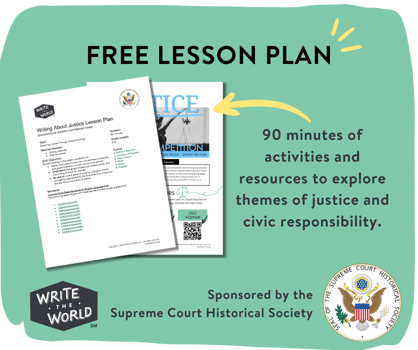
The “Writing About Justice” lesson plan guides students through defining, comparing, and personally contextualizing the concept of justice before crafting an original creative writing piece for a national competition. It blends discussion, global analysis, reflective activities, and rapid‑fire writing to help students in grades 6–12 explore how justice operates in their lives and across different governmental systems.
The Supreme Court Historical Society is a 501(c)(3) nonprofit membership organization dedicated to preserving and collecting the history of the United States Supreme Court, increasing public awareness of the Court's contribution to the constitutional heritage of the United States, and acquiring knowledge covering the history of the entire Judicial Branch.
Key takeaways:
- Scaffolded writing activities help students analyze justice through historical and literary lenses.
- There are great opportunities for cross‑curricular collaboration between ELA and Social Studies, meaning students deepen their conceptual knowledge and ability to integrate what they are learning across classes.
Suggested classroom uses:
- Scaffold a stand‑alone writing workshop.
- Integrate into a civics, government, or history unit.
- Adapt for middle vs. high school with differentiation tips.
- Encourage students to enter the Justice Writing Competition in October, using these activities to scaffold their participation.
BONUS: Lesson Planning Webinar August 17, 2026
Join Write the World and the Supreme Court Historical Society on Monday, August 17 at 5 pm EST for a free professional development webinar where you'll engage in collaborative lesson planning to integrate the upcoming writing competition into your curricula! This workshop is free for educators; learn more and register today to reserve your spot!

Resource #3: Democracy Class from Rock the Vote
Democracy Class is a free, nonpartisan curriculum that educates high school students about the importance and history of voting. This resource requires educators to sign up to receive the curriculum and training materials.
Key Takeaways:
- Videos and interactive activities resonate with teens.
- A strong democracy depends on active participation.
Suggested classroom uses:
- Ready‑to‑use lesson plans on voting, civic participation, and media literacy.
- Perfect for Constitution Day, election‑year programming, or advisory periods.
- Could pair with student‑led discussions or schoolwide civic engagement events.
Resource #4: Dynamic, Hands-On Activities That Immerse Students in Civics from Edutopia
Edutopia interviewed several high school history, government, and civics teachers and coordinators to share 9 dynamic, hands-on activities that immerse students in civics. Real‑world civics experiences, including internships, community service, meeting with representatives, or helping shape school policies, make classroom learning more concrete and impactful. When students engage directly with civic processes, they see how their studies connect to real issues and communities.
Key Takeaways:
- Civics takes on new life when students have real-world experiences like creating polls or ballots or touring a local government building.
- Classroom-tested activities from teachers across disciplines.
Suggested classroom uses:
- Inspiration for updating existing units or creating new activities.

Resource #5: Defining Democracy from Facing History & Ourselves
Key takeaways:
- Shared values, civic participation, and community engagement strengthen democratic systems.
Suggested classroom uses:
- Use to build a culture of inquiry and empathy.
- Integrate into units on Reconstruction, civil rights, or global democracy.
- Set the foundation for a broader unit on what makes democracy work.
- Whether or not you live in a democratic governmental system, use these resources to scaffold students’ comparative analysis skills as they learn about different forms of government.
Resource #6: Civics in Action
Write the World’s 2020 Civics in Action program brought together a global cohort of teens (ages 15–18) for ten months of synchronous writing, civic inquiry, and journalism practice, resulting in more than 100 original pieces across genres—from op-eds and reportage to speeches, letters, and cultural critique. In partnership with Facing History & Ourselves, Parentology, and the National Children’s Campaign, the program invited students to explore issues such as racial equity, global citizenship, democracy, activism, and healthcare. Read the curated edition of Write the World Review.
Key takeaways:
- Highlights how young writers met a historic moment with honesty, research-driven advocacy, and hope—grappling with questions of impact while drawing inspiration from mentors, elders, and community members.
- Offers a powerful reminder of how youth writing can distill human values, deepen civic understanding, and illuminate the collective work of imagining and shaping a better future.
Suggested classroom uses:
- Mentor texts for teens
- Reflection questions to guide further discussion.
Bringing It All Together: Designing a 250th Anniversary Civics Unit
Are you now prepared to design your own 250th‑anniversary civics unit? Feel free to mix and adapt these resources to fit your classroom! Consider collaborating with colleagues across ELA, History, Government, and Civics to deepen the experience, provide interdisciplinary connections and increase classroom time dedicated to literacy.
We also pulled together some culminating project ideas:
- Students can enter a creative writing project into the Justice Writing Competition in October.
- Schoolwide Democracy Expo Gallery Walk of project posters and/or creative works.
- Digital storytelling about justice, rights, or civic identity combined into a slideshow or video.
As the US approaches its 250th year, strengthening civic literacy remains essential. We invite you to share your own civics activities and reflections with us at educators@writetheworld.org!