
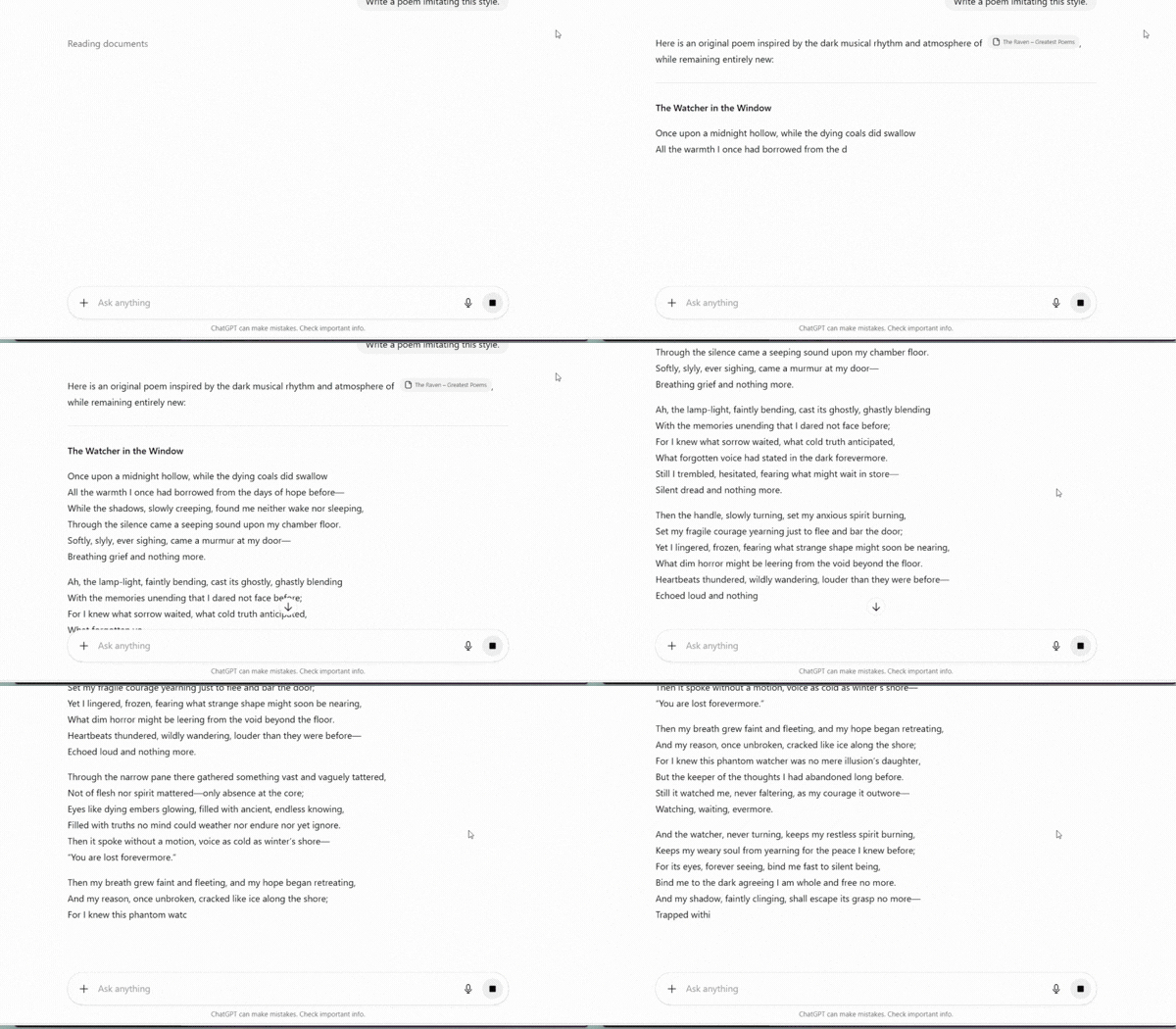
As a poet, I’m curious about the current cultural obsession with ChatGPT. A month ago, I tried a little experiment. I selected twenty-three poems I’ve written—the ones I like the most—and copy-pasted them into the platform. After having it identify the recurring themes in my work and analyze my voice, I asked it to generate a twenty-fourth poem that imitated my style.
Despite repeated attempts, it couldn’t. “There’s something off in its poems,” I thought. I couldn’t place my index finger on what it was. Yes, ChatGPT failed to use formal constraints—rhyme and meter—the way a technically proficient poet would, but there was more than that. Its work just felt…artificial. Soulless. It had none of the ache, tenderness or humor that my poetry contains, and it evoked no deeper insight, even if some of its lines were beautiful.
So, with these limitations, why do people still use AI to create?
For one reason: convenience. I disagree, though, that the future of AI in literature involves a hybrid model in the sense that the people around me understand the term. For instance, some of my high school classmates assumed that they could generate their English essays or Biology long-form responses using AI chatbots, then edit them to sound more ‘human’. But the written word, which is shaped by our personal experiences and unique perspectives of the world, is fundamentally human.
AI can’t ‘write’; it only uses large language models (LLMs) to predict the order of words in a sentence, based on the range of written sources fed into its training data. But the fact that it can even do that scares me because, to unpracticed eyes, AI-generated writing sounds convincing. A 2024 Nature study claims that “AI-generated poetry is indistinguishable from human-written poetry”—maybe since AI’s directness makes it more accessible to people who don’t read poems.
Is AI-generated poetry indistinguishable from human-written poetry?
Literature is a product of its time. After OpenAI launched ChatGPT in November 2022, other AI chatbots began developing faster than society could adopt them. While this emerging technology fascinates writers, we have to be aware of its potential dangers.
Potential Dangers of AI in Writing
- Since most AI models are trained on similar, overlapping public data sources, AI-generated writing sounds unvaried and emotionally flat, making it less compelling than a human’s writing; this homogenization results in readers losing long-term interest in literature.
- A phenomenon known as cognitive outsourcing shows that over-reliance on AI can reduce a person’s critical thinking and creativity, because when writers don’t engage as actively with words, it can hinder the “brain’s ability to form and strengthen neural pathways”.
- Plagiarism is one of the main reasons why using AI can be unethical. A GothamGhostWriters study found that, out of the 1,481 writers they surveyed, 61% of them used AI in some way—7% of which published wholly AI-generated content. Wholly AI-generated self-help books, novels, and poetry collections are published every day—like on Amazon’s Kindle Direct Publishing, where the platform’s policy doesn’t disqualify AI usage, raising legal concerns about their authorship and social concerns about their quality, because they’re generated so quickly.
However, not all AI uses are the same—and some of them even excite me, like the idea that AI can translate ancient literature and could make future human-written novels interactive by incorporating transmedia.
Potential Opportunities of AI Usage in Writing and Reading
AI models are becoming multimodal, meaning they can process images, audios and videos. Current attempts are seen in video games such as DREAMIO: AI-Powered Adventures, where AI “dynamically generate(s) stories, illustrations and voiceovers in response to player input”. If introduced in literature, this would influence the reading experience as different perspectives of the same story could be shown through multiple platforms and media formats, transforming readers from passive consumers into active participants.
AI can also be used in the bureaucracy and administration of the literary world. Publishers and literary journals can utilize AI to create social media posts, market their content, and for predictive analytics—where chatbots predict which genres of books are likely to succeed in the coming months for specific demographics. These practices would allow literary agents and poetry editors to publish and promote writing according to their readers’ interests.
Equity Considerations
There are pros and cons: By acting as an echo chamber of familiar content and limiting users’ exposure to writing from non-Western perspectives, which might not have been ‘best-sellers’ historically, AI might cause literature to be less diverse. But the above business uses could enhance efficiency, supporting the economic survival of administrative teams by reducing the time and costs associated with editing and marketing. With mundane tasks sorted, people have more room to create.
Another future use of AI is a process called localization, which means to edit written work into different cultural contexts. Flattening literature to be more digestible for a general—often Western—audience is dangerous, since the author’s intention and the piece’s sensitive nuance would be lost, even if the content is more accessible.
Action Steps for Ethical AI Use
Now, based on what you’ve learned about the ethics of AI from this article, here are ways you can use it more mindfully:
-
- As a ‘super Google’:
- AI can summarize information and provide supporting links for its claims, so it can act as the launchpad for further, more extensive research.
- If there's a word lodged in the bottom of your throat but you just can’t reach it, AI can help by acting as a dictionary and thesaurus.
- As a second pair of ‘eyes’:
- AI can analyze your work and tailor its feedback according to your needs based on how you prompt it—whether you want to hear encouraging words or constructive criticism.
- This usage, known as literary forensics, would allow you to gain awareness of your writing habits and learn how to vary your style.
- This is useful if you want thoughts on your writing but you don’t have access to a platform where you can receive it, such as a workshop community, or are too shy to share your work with another person.
- As a proofreader.
- As a ‘super Google’:
Write the World’s Socratic-Method Clara AI
Write the World’s AI, Clara, is an ideal example of how the technology should be used. You can copy-paste a section of your writing—within 500 characters—into Clara; then it provides specific feedback and asks open-ended guiding questions, helping you explore how to edit or continue your piece. Clara isn’t able to generate new content for you. Using a generative and transformer-based AI like ChatGPT is less ethical than using Clara, a Socratic model.
.png?width=600&height=338&name=clara-teen-quotes-email%20(1).png)
I’m reminded of a reel I saw while scrolling through Instagram one Sunday afternoon. It showed AI’s attempts to generate human hands—how it drew flat blobs or six fingers where there should be five—then, in the next frame, there were images of cave walls covered in handprints. Some broad as footballs, some slender, but all of them were real. Were our ancestors’. So, don’t be too worried. Us writers aren’t going anywhere, especially now—when human vulnerability is infinitely more valuable.
Author Bio
My name is Iffah Shamim. I’m a 19-year-old Pakistani on a gap year after graduating high school. I moved to the UAE when I was 4, lived there for 14 years and am now based in Sialkot, Pakistan. I write poetry in my spare time. Though I focus on using traditional forms, my free verse has been published in Fahmidan Journal and Blue Marble Review. Having fallen in love with creative writing in 6th grade, I can’t imagine how dull my life would be without the beauty that words hold. But I’m an academic at heart: I love exploring the intersection of literature with other fields, particularly AI and biochemistry.