
"By drawing on my own experiences, I hope to create work that allows other bicultural individuals to feel seen – while also, in the process, making myself feel seen too," said winning screenwriter Lily Wynyard.
March 2026 marked Write the World's first ever Screenwriting Competition, guest-judged by Zoe Cheng. We were honored to receive hundreds of fascinating entries from teens all around the world, including the three winning pieces and peer review featured below.
Read on to immerse yourself in these teens’ expert advice on writing and the creative process.
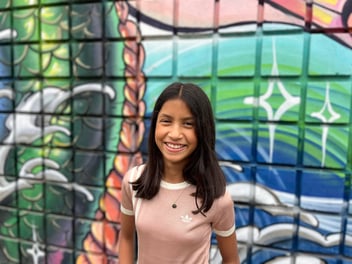
Winner: Lily Wynyard, age 17, New Zealand
Read the winning piece here!
In the footnotes of your winning piece, you describe your biculturalism as a source of inspiration for "Fish Creek." Can you talk a little more about this complex duality and how it comes through in your work?
I like to think I carry my cultural heritage with me throughout my writing journey. Growing up, I often felt caught between two worlds – one side of my family I didn’t physically resemble, and the other living halfway across the world. My biculturalism was never a clean division of halves; instead, it overlapped in ways that sometimes left gaps, and sometimes I didn’t feel fully seen by either side.
At the same time, growing up in a culturally diverse country like New Zealand reminded me that I wasn’t alone in my experiences. There were others navigating these in-between spaces.
Writing became a way for me to explore that complexity. By drawing on my own experiences, I hope to create work that allows other bicultural individuals to feel seen – while also, in the process, making myself feel seen too.
Guest Judge Zoe Cheng describes your piece as "heart-wrenching" and "lovely, almost magical in feel." When did you discover your love for screenwriting?
I’ve been writing for as long as I can remember, mostly short pieces I could finish in an afternoon. As I grew older, I started attempting longer projects, though many of them ended up sitting unfinished in my Google Drive!
I discovered my love for screenwriting alongside my love for film. It felt like an entirely new way of telling stories. At first, I was writing draft screenplays for films I never expected to exist.
That changed in my Media class, where I had the opportunity to not only write screenplays, but actually bring them to life on screen. Seeing something that once existed only in my head become real was incredibly rewarding, and I loved every part of the process.
Because screenwriting combines two of my passions – film and writing – it's a path I hope to pursue, and something that my mind keeps coming back to when thinking about education after high school.
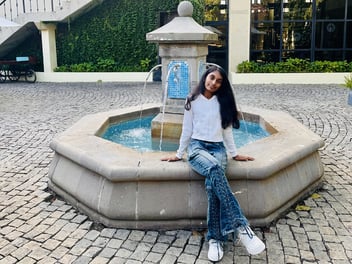
Runner-Up: Luna Thuy Scenna, age 13, Australia
Read the runner-up piece here!
Your dialogue was praised by Guest Judge Zoe Cheng, who explains, "good dialogue almost immediately transports us to a place and time, and this piece does an excellent job at that!" How do you approach dialogue, and what inspires you?
I would like to thank Guest Judge Zoe Cheng for her lovely comment. To answer your question on my approach to dialogue, it would essentially be to sound as realistic as possible, like how a person would likely act in such a situation. People don’t usually talk with metaphors, so I save metaphors for prose rather than the dialogue. The same thing goes for lush description and other forms of rhetoric. What inspires my dialogue is a multitude of great books and great movies, especially the dialogue used by Quentin Tarantino.
What is the larger metaphor in your piece, and how does it relate to some of the philosophers mentioned in your footnote (Plato, Kant, Descartes, and Schopenhauer)?
The larger metaphor for my piece was this: a life without passion is a life wasted, but a life with passion results in happiness. All the characters have almost given up, succumbing to the oppressive forces, but a man called Boris lets his passion remain despite the uncertainty and dim circumstances. His passion and enthusiasm eventually starts to shine a light on the other prisoners, not only helping Boris himself but others. This relates to the philosophers (Plato, Kant, Descartes and Schopenhauer), as they all believed that the world we experienced was not the true world, yet they all remained living, driven by their passion of philosophy.
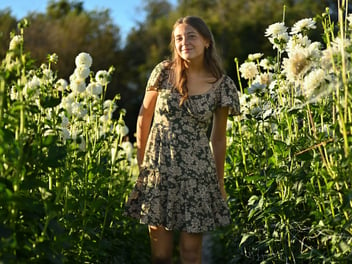
Best Peer Review: Aaranya Rakhunde, age 15, India
Read the winning peer review here!
How is reviewing screenwriting different than reviewing other forms of writing?
Screenwriting feels quieter on the page. It relies not only on what is written, but on what is seen and what is left unsaid. When reviewing it, I find myself paying attention to rhythm, to pauses, to the weight of silence. It becomes less about describing and more about understanding intention — how emotion might unfold on screen, and how absence can sometimes speak louder than dialogue.
What’s your favorite movie, and how does the screenplay make it great?
One of my favorite films is Atonement. Its screenplay is compelling in the way it bends perspective and memory, allowing the same moment to exist in different truths. What we see is not always what is, and that quiet shift reshapes everything. It does not just tell a story, it reflects on storytelling itself, which makes its impact feel both intimate and quietly devastating.